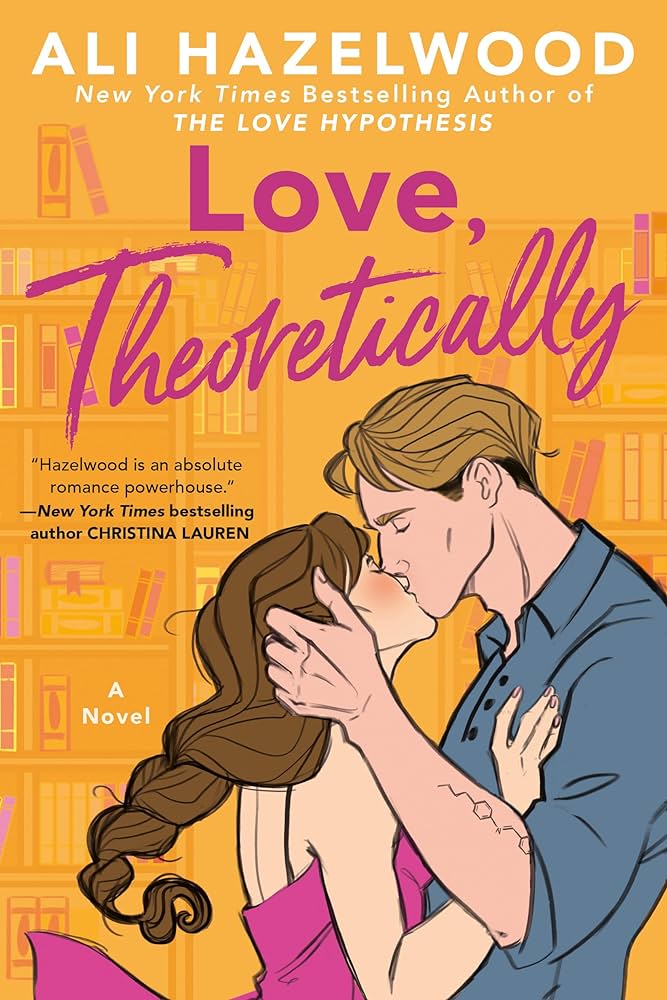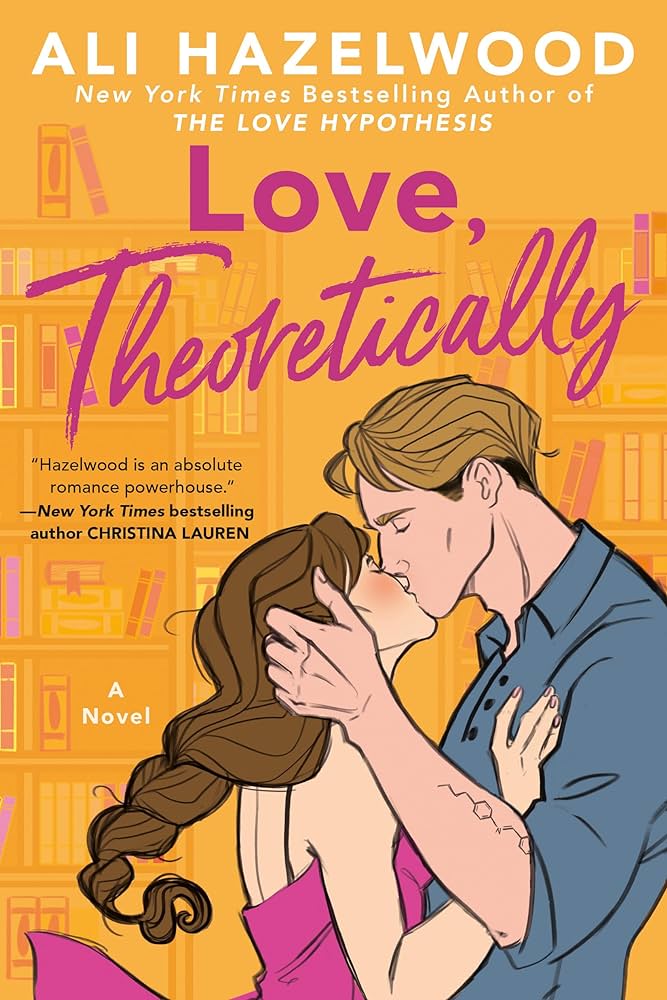
A thoroughly enjoyable (and surprisingly spicy …) academic enemies-to-lovers romance
“Love, Theoretically” was my second romance audiobook in my journey into the genre, again prompted by a recommendation on the It’s a Clue podcast if I recall correctly, though I had seen this book floating around a bit for a while before I decided to use my monthly Libro.fm credit on it. It’s the story of Elsie Hannaway, an adjunct professor applying for a tenure track position at MIT, and the friction (and heat!) generated when she bumps against Jack Smith, an experimental physicist on the selection committee. The story revolves around a prank that Jack pulled as a precocious teen that ruined Eslie’s mentor’s career, and the mystery of Jack’s mother’s early career as a theoretical physicist in her own right.
I recall the real world case of the prank that Jack pulled, the so-called Sokal Affair: physicist Alan Sokal got a paper published in the cultural studies journal “Social Text” that was largely and intentionally bunkum as an attempt to prove that the journal (and the discipline in general) lacked academic rigor. I had recently finished my MA in American Studies, in which I suffered through a horrific literary criticism course taught by a professor who was proud not to have read a novel in more than a decade, and I had mixed feelings about it: on the one hand, anything skewering the dross that was lit/cult crit of the ‘90s warmed my heart; on the other hand, qualitative studies of culture are valuable in their own right, and having someone outside the discipline pull this prank raised my hackles.
Hazelwood recasts it as a conflict within physics itself, between experimentalists and theoreticians, which blunts the blow a bit for me. I don’t know that academic physics is indeed divided in the ways presented in “Love, Theoretically” — it seems unlikely. However, as a way to get at the fundamentally petty conflicts in academia that are raised to extreme levels of personal and professional animosity, it was a nice vehicle.
“Love, Theoretically” is certainly an academic novel, and so fits within the same space as “Lucky Jim,” “Possession,” and “The Secret History,” though its tone is definitely lighter than the last two of these and a bit less satirical than the first. Its focus is more on Elsie’s personal struggles — she’s a “people pleaser” who has trouble standing up for herself, and her relationship with Jack helps her find her voice — than on her academic struggles.
This was my introduction to the “enemies to lovers” trope, and I enjoyed that aspect immensely: the friction and tension between the main characters gives a lot of depth to their relationship, and generates a lot of heat. (Chapters 19-22 are surprisingly filthy — I wasn’t prepared for quite that much heat …) The characterization and writing are entertaining, and the story moves along at a good clip. I’ve added more Hazelwood to my TBR stack (I picked up a copy of “Love on the Brain,” another academic romance, to put in my travel bags for an upcoming trip). I’d recommend you do the same if you like spunky heroines, interesting conflict, and a little spice.