
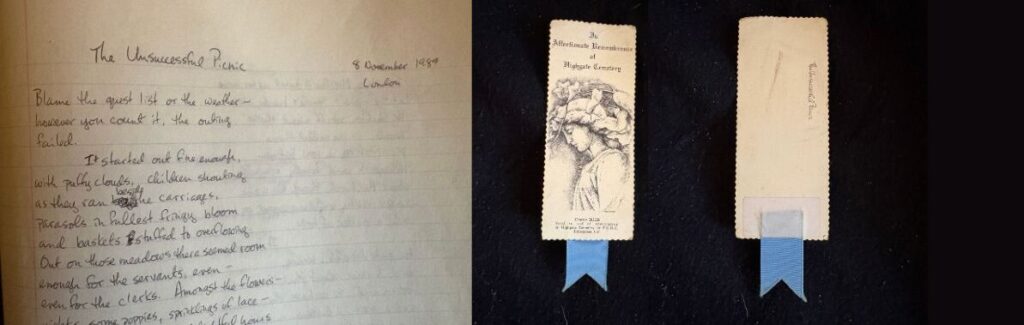
I was cleaning out some old papers and found a bookmark (pictured above) that I bought at Highgate Cemetery in London in 1989. I used it as my bookmark while reading “In Memoriam,” as it seemed more than a little appropriate for that book.
On the back of the bookmark (also pictured) I had written “The Unsuccessful Picnic.” Memory is, of course, a faulty tool, but I seem to recall scribbling this on the Tube ride back from Highgate to the Queen Mary College student high rise in South Woodford: the inspiration had come to me during the tour of the cemetery (still one of the best tours I’ve ever taken), when the guide showed us General Loftus Otway’s tomb and told the spurious tale of its part in the origins of Bram Stoker’s “Dracula.”
The story (certainly false, but it deserves to be true!) was that Otway’s family would come up to London by carriage from their home in Surrey and visit the tomb. As it was often late in the day by the time they arrived, they would enjoy a midnight picnic in the mausoleum. Bram Stoker was at the time living nearby, and was enjoying a late ramble through the leafy cemetery when he heard the tinkling of wine glasses and saw the glow of candlelight from the tomb and so was born the immortal tale of an undead Transylvanian nobleman and his sketchy real estate grift in London.
This story has been attached to other tombs as well, and isn’t attested in any of Stoker’s notes on “Dracula.” As this great blog post by Sam Perrin explains, the connections between Stoker and Highgate and “Dracula” are tenuous at best (though the story of Dante Gabriel Rossetti retrieving a manuscript from the grave of his dead wife, Elizabeth Siddal, is surely as gruesome and gothic as any of Stoker’s tales and so I don’t mind at all that my youthful incredulity has been dashed).
At the time of my stay in London and my visit to Highgate, I was consuming a lot of late Victorian and Edwardian literature. E.M. Forster was my favorite, and I remember reading Maurice, The Celestial Omnibus, and A Room With a View that semester. I must have just read “The Story of a Panic” from “The Celestial Omnibus,” and it left its marks on the poem below, which was intended to be about the sweeping away of the Victorian order by the First World War.
The Unsuccessful Picnic
Blame the guest list or the weather —
however you count it, the outing
failed.
It started out fine enough,
with puffy clouds, children shouting
as they ran beside the carriages,
parasols in fullest fringy bloom
and baskets stuffed to overflowing.
Out on those meadows there seemed room
enough for the servants, even —
even for the clerks. Amongst the flowers —
violets, some poppies, sprinklings of lace —
we settled in for some delightful hours
away from the bricks and mortar,
basking in Romance —
ah, sweet! —
and idle talk. Poetry, perhaps.
But when the baskets opened and we began to eat
those daintily-wrapped scones
it became clear the invitations had
gone all out of hand.
Or perhaps —
perhaps no one had invited at all! Mad!
As though a word dropped to the maid —
“It’s a lovely day this Tuesday next,
we shall pack for an outing, shall we?”
— carried the weight a neat text
in ink sealed in red wax, as if that,
a casual word spoken, would suffice
as impetus to bring her uncle and cousins
along as well. The Heath is just as nice —
why must they come along with us?
So while Mrs. Harris turned up her nose
at the maid’s uncle’s bawdy jokes,
Mr. Shafton set off about “those”
people, as he called them,
precipitating a row between
Hollingworth and Peabody nominally
about the Church, though the scene
hinged really on a disagreement of taste,
only a matter of taste.
It turned
tea quite dreadful, really,
and I must admit that I yearned
for an end, so perhaps the rain
was a boon, a Godsend, a gift
to my weariness, though we were hardly
refreshed by the winds that lifted
fragile parasols aloft and scattered
our crumbling picnic. A shame,
a bloody — there, I said it! — shame.
Not to be avoided, though; storms
have their own rules to follow
and it does no good to wallow
in self-pity over the uncontrollable.
Even though I wished for that rain.
If just to end it all, to keep me sane
in the midst of Mrs. Harris rolling her eyes.
But those poppies — slick, red, wet —
and the tipped marmalade, trampled bread,
and the maid’s uncle laughing and crying
while the carriages scattered
in that storm, nothing mattered.
Not even Romance.
8 November, 1989, London