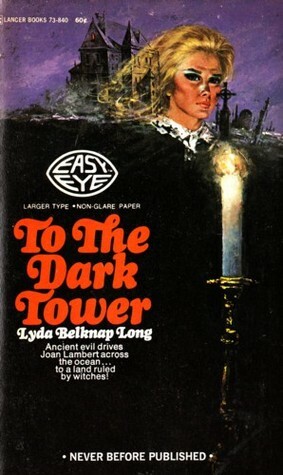
Pursued by a strange experience in a remote cave in Spain, archeologist Joan Lambert travels to Kentucky to reunite with her lover. She finds herself the target of a mysterious cult of hooded figures, in a town where she cannot tell friend from foe or madness from sanity.
I really wanted this book to live up to the promise of its authorship: Lyda Belknap Long was, obviously, a very poor pseudonym for Lovecraftian author Frank Belknap Long, one of six Gothic romances Long published in the late 1960s and early 1970s, the heyday of the women-with-great-hair-fleeing-spooky-houses paperback. Surely some eldritch horrors and nameless cosmic dread thrown into the Gothic blender can only result in a delightful concoction!
Alas, this feels like half a book at best, tossed together slapdash with minimal characterization, a sketchy concept, and barely a glimpse at a toad-like totem around which a coven of naked Satanists dance. The action takes place over the course of a couple of days, is confusingly conveyed, and has no gibbering madness on offer. I wasn’t a huge fan of The Wind at Winter’s End, another Gothic romance of the era published pseudonymously by another horror writer (Charles Grant), but that book was a far sight better than “To the Dark Tower.”
The protagonist barely has agency, there’s hardly any “romance” in the story, and it all wraps up with a tidy deus-ex-machina with no foreshadowing. Ugh.
(I should note that I’m currently tossing around a couple of Gothic ideas myself, which I hope to pull off better than these two novels were; I’m not convinced that Long actually liked the Gothic genre at all, which is an absolutely necessary requirement to pull off even a pastiche — KJ Charles obviously loves the genre in all its sweaty silliness, and it shows in her much more enjoyable story. I chalk it up to Long’s misogyny, which drips off every page almost as thickly as his casual ablism.)