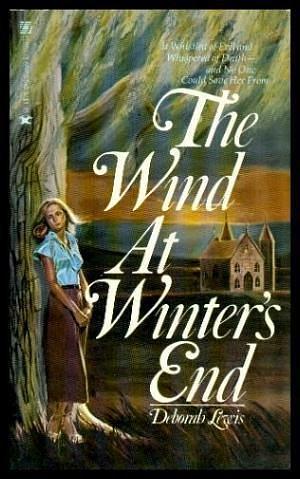
Glenna, a young American woman, is visiting relatives in England at the familial estate, Winter’s End, while her widowed father is on business in Germany. Glenna spends her days riding on the wooded grounds, but her peaceful visit is shaken first by the appearance of her cousin Nigel’s handsome and mysterious business partner, Roger, and then by witnessing the apparent murder of the cook (followed by being knocked unconscious, possibly by gear falling on her in the stable where the cook’s body lay). No one believes her about the murder, though, and when the cook returns from a family visit, apparently none the worse for having been brutally killed, Glenna begins to doubt her sanity.
I found “The Wind at Winter’s End” on the $1 spinner rack at a local science fiction bookstore, and grabbed it because the price was right and because it looked like a Gothic paperback of the sort that was common in the ’70s and ’80s. It was only later that I learned “Deborah Lewis” was a pen name of Charles Grant, a prolific author of “quiet horror” (and the occasional X-Files novelization). I’ve read a few of his short stories, and hoped that I was in for a treat with his take on the women-with-beautiful-hair-running-from-houses genre.
Alas, I was not especially taken with “The Wind at Winter’s End.” Coming in at just over 200 pages in its paperback edition, it has far too many characters and far too complex a scheme behind it for its slim size. There isn’t enough space to flesh out and differentiate the characters, explore their motivations, or build on the atmosphere of dread and confusion. The scheming cousins who put the deceptive and deadly plot in motion feel like side characters until the very end, and the dark and mysterious love interest is barely on the page at all; we spend too much time with Glenna lying in a dark bedroom in a daze after her blow to the head, and the reader is just as confused as she is, but not in a good way. With a little more room to stretch and breathe, this could have been a fun entry in the contemporary Gothic genre, but instead it feels like it was dashed off in a rush.
There are some nice set pieces, though, very much in the tradition: Glenna’s wild ride through the dark woods after discovering a frightening secret, her escape out a window of the library onto the mansion’s narrow second story ledge, and the climactic dark magic ritual are fun and grippingly told. And, not surprisingly, Lewis/Grant does a good job with atmosphere, as the eponymous wind rises throughout the tale, adding to the ominous dread one wants from a Gothic.
Would I grab another Deborah Lewis book off the spinner rack if I spotted it? Absolutely; the covers, at least, look fun. But I’d go into it with tempered expectations.