Caesar Pokoli, New York City’s commissioner of the Department of Miscellaneous Complaints, notices a sidewalk crack outside the newly constructed municipal services complex. He reluctantly raises the issue, knowing that it will likely come back to his department. Meanwhile Marianne, his hyper-promiscuous wife, is arranging an assignation with George Goodrow-Blakeley, a reluctant British geology professor. Soon Caesar, Marianne, and Goodrow-Blakeley are embroiled in a raunchy comedy of errors as the sidewalk crack grows to a chasm bisecting Manhattan, triggering a cascading crisis of social, political, and religious consequence.
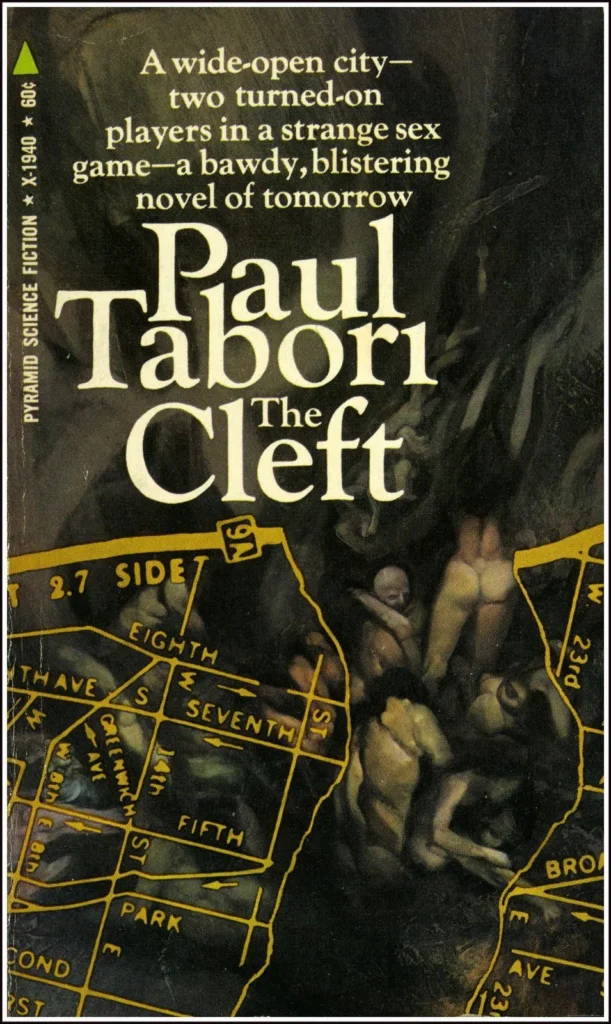
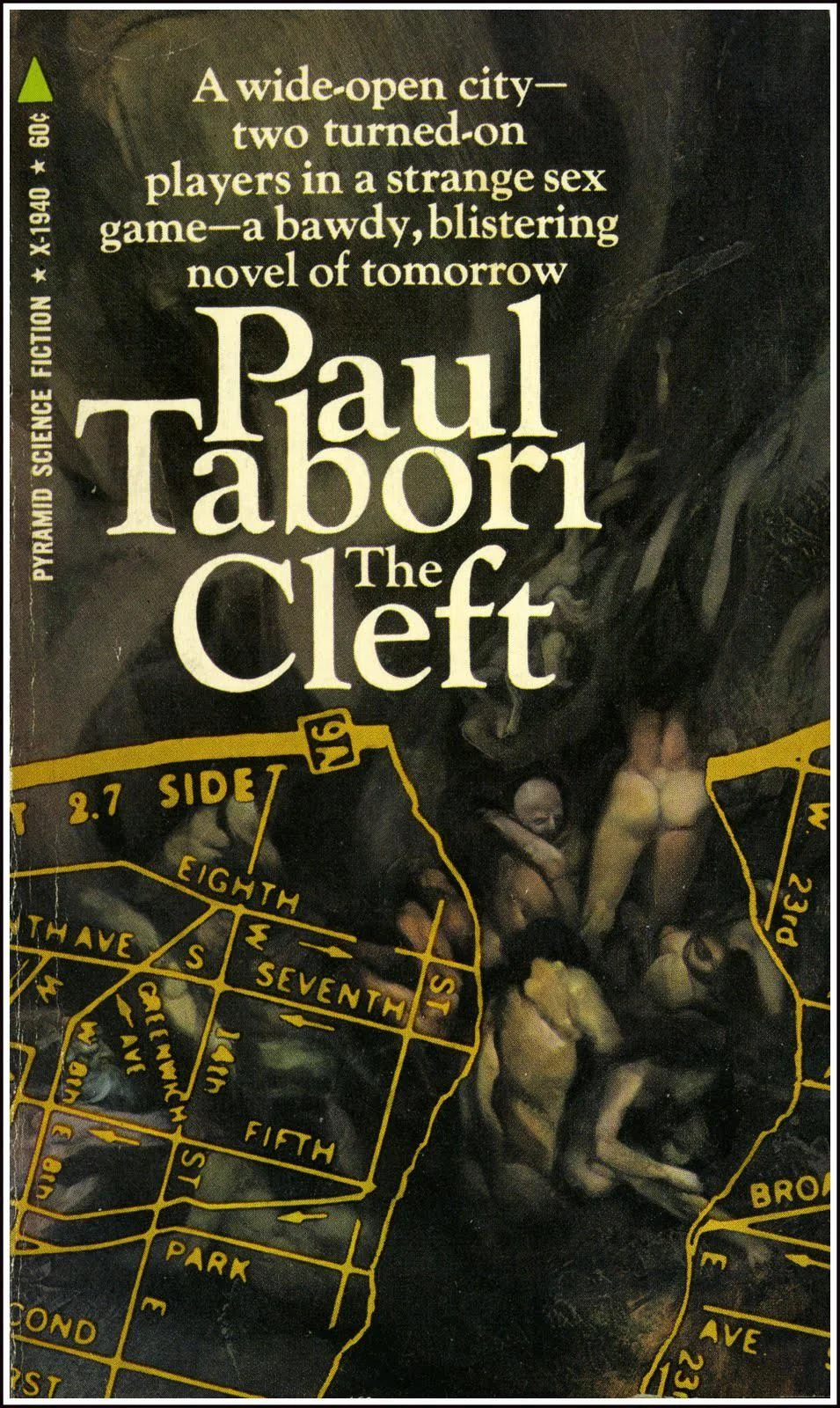
I picked up “The Cleft” from the dollar rack at the science fiction used bookstore, so I really shouldn’t be annoyed that it failed to live up to the promise of its cover blurb: “A wide open city – two turned-on players in a strange sex game – a bawdy, blistering novel of tomorrow.” Nor even more so to the back cover copy: “a science fiction novel like none other you have ever read. As vividly visionary as H.G. Wells, as wickedly witty as Terry Southern …”
“Wide open city?” Well, there is the weird canyon suddenly crossing Manhattan, so there’s that. “Two turn-on players in a strange sex game?” Marianne randomly chooses her partners from the phone book with a golden push pin, which is sort of a game I guess, and she and George do get it on a few times. But a “blistering novel of tomorrow”? It’s set in 1986, 17 years from its 1969 publication date, so I guess it’s tomorrow. But it’s hardly “blistering” or “visionary,” and bears no resemblance whatever to Wells.
It is probably in the vein of Terry Southern’s “Candy” or “The Magic Christian,” with broad attempts at satirizing city politics and bureaucracy, loose sexual mores, and “kids these days,” but it’s rarely particularly funny. There’s casual sexism, racism, and homophobia scattered throughout, along with half-hearted efforts to mock hippies, religious fanatics, and academics.
There was one weird scene where Marianne encounters a pair of strange creatures after a car wreck, about three quarters of the way through the book, and I thought, “At last! The promised science fiction! Surely these are otherworldly monsters emerging from the mysterious Cleft!” But no — they were just incongruous drag queens in rural upstate New York, and it was just a set piece for Tabori’s homophobia to run wild.
The book also suffers from odd pacing. It’s off to a slow start, with a lot of scene setting and world building that ultimately comes to nothing, delving deeply into the lives of some side characters who quickly disappear. Then it picks up the pace near the end, with a race against time and missed connections as Caesar tries to deliver his wife’s geologist lover to the mayor as a solution to the cleft. And then stumbles pell-mell through an unsatisfying conclusion in the last few (strangely formatted …) pages. It could have been a breezy two-sitting read at about 170 pages, but instead it felt like a slog.
Based on his Wikipedia page, Tabori lived an interesting life, fleeing the Nazis from his native Hungary and making a career adapting Kafka for the stage and practicing psychoanalysis in London. But “The Cleft” is decidedly un-interesting, except as a time capsule of its era’s hang-ups and prejudices.