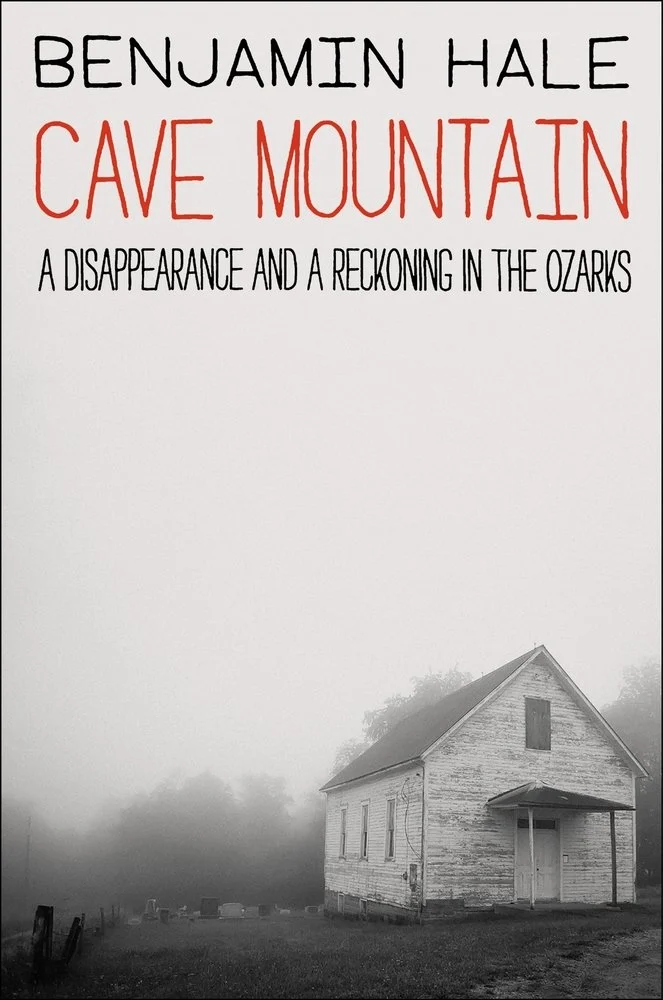
In April 2001, a six-year-old girl goes missing in the Buffalo River Wilderness in the Arkansas Ozarks, prompting the largest search and rescue effort in the state’s history. When she’s found two days later, she tells of her imaginary friend, a four-year-old girl named Alicia, who guided her to the river with her flashlight and kept her entertained with games of patty-cakes. This imaginary friend seems an eerie echo of a three-and-a-half-year-old girl who was murdered by a small cult nearby in 1978.
Cave Mountain is a frustrating book, and not always in a rewarding way. Hale spends far too much time in discursive anecdotes about his extended family (the girl who was lost in 2001 is his cousin), often with footnoted asides, that builds a dense but oddly unrewarding texture. Many of the details of the search are interesting, but in the end contribute little to the narrative; with so many details, the reader struggles to sort the important from the incidental.
The section on the 1978 murder is more interesting, though also presented in an often rambling and discursive fashion, with many minor players getting a lot more page time than is warranted by the story. The effort Hale puts into the reporting is impressive — surprisingly few records from the time exist, and he has to rely on the faulty and often contradictory memories of participants with their own agendas — but I came away feeling I understood less about the case than I should, considering the volume of pages I read.
And then there’s a meander into a 1982 bus hijacking by religious zealots in nearby Jasper that has nothing to do with the stories of the little girls, except that the sheriff involved in the 1978 murder who also helped in the 2001 rescue played a part. That could probably have been handled in a paragraph or two (or, perhaps, one of the author’s chatty little footnotes …).
The most enraging part of the book, though, is what appears to be an attempt to forgive, or at least to mitigate, the injustice of one of the people guilty of the little girl’s murder through a lengthy digression on the Prodigal Son and the concept of divine grace. Suzette Freeman, the cult’s prophet’s “interpreter” and de facto leader, made an immunity deal for her testimony — a deal the prosecutors absolutely should not have offered — and went on to live out her life in freedom, dying in 2019 at the age of 72. Hale interviews her brother, who spends a good deal of time trying to convert him to a particularly noxious sort of evangelical Christianity, and though Hale claims not to have taken that particular bait, he certainly has his head turned in some regrettable ways.
One cannot, of course, dig up the bones of someone who escaped justice in this world to exact any sort of divine vengeance, but I find it objectionable to accept that she should be remembered as anything but a monster who facilitated a child’s murder.
There is, I think, I a good book in here, but it would have to be much shorter, better edited, and perhaps written by someone not so close to the story.